
CompTIA A+ vs Cisco CCNA: Which IT Certification First?
Side-by-side: CompTIA A+ for IT support entry, Cisco CCNA for networking. Which fits which Charlotte career path, and how to stack them.
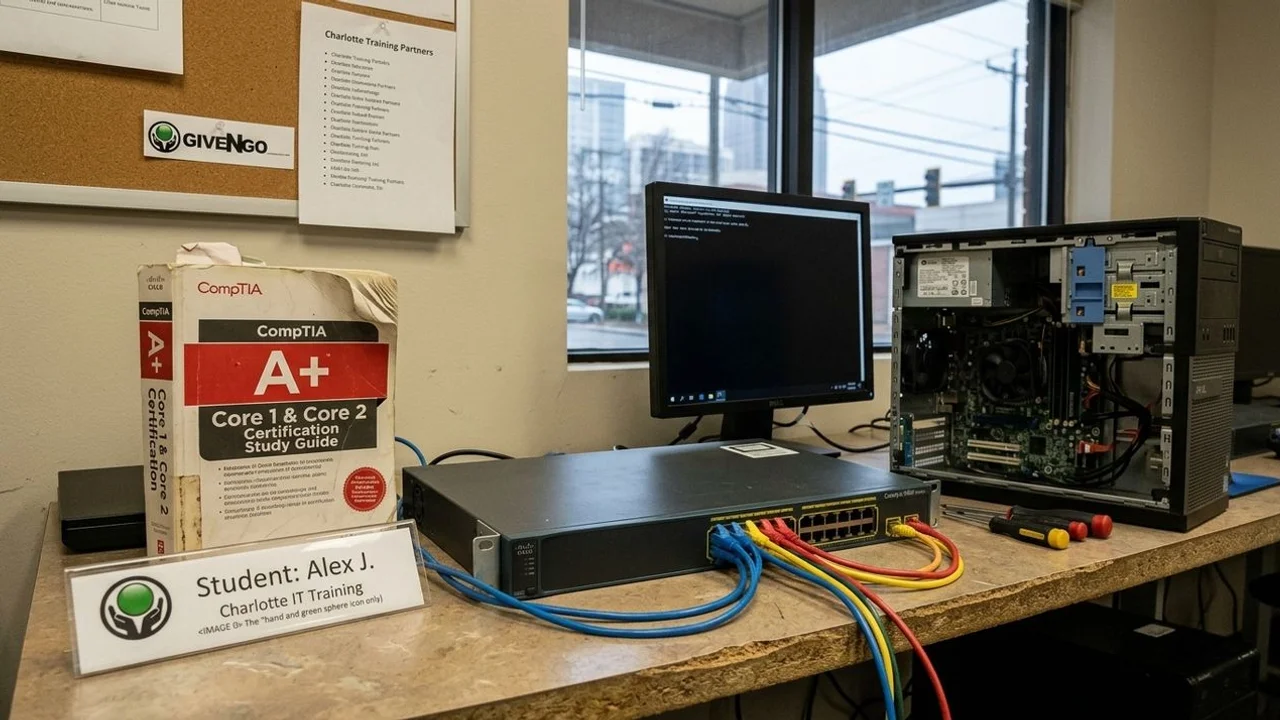
We constantly hear from local business owners who want to understand the real difference between CompTIA A+ vs Cisco CCNA for their IT hires. Charlotte IT careers split into two main first-cert paths: CompTIA A+ for the IT support side, and Cisco CCNA for the networking side.
Our team usually recommends starting with A+ and stacking CCNA later.
This sequence builds a solid foundation for the IT support certifications Charlotte employers value most. Let’s break down the 2026 exam costs, local salary data, and specific job roles so you can decide which IT cert first makes the most sense.
CompTIA A+ in One Paragraph
CompTIA A+ is a vendor-neutral, entry-level credential that validates a technician’s ability to manage hardware, operating systems, and basic security. The certification requires passing two separate exams, known as Core 1 (220-1101) and Core 2 (220-1102).
Our local data shows this is the standard “first cert” for help desk and desktop support roles. Preparing for both tests gives a candidate several distinct advantages:
- Hardware mastery: Technicians learn to physically repair desktops and laptops.
- Software troubleshooting: Staff can resolve Windows, macOS, and Linux issues.
- Baseline security: The curriculum covers essential malware removal and data protection.
We track the costs closely, and as of 2026, each exam voucher costs roughly $253 in the US. That brings the total investment to about $506 just for the testing fees.
The credential remains valid for three years.
Cisco CCNA in One Paragraph
Cisco CCNA (Cisco Certified Network Associate) is a networking-focused credential that proves an individual can configure, troubleshoot, and manage complex network infrastructures. Passing the single required 200-301 exam demonstrates deep knowledge of IPv4/IPv6, routing protocols, and security fundamentals.
We consider this a vendor-leaning certification because it centers heavily on Cisco gear. That said, the underlying concepts apply universally to any enterprise network environment you might operate.
Pro-Tip: Many seasoned engineers recommend mastering IP subnetting before even booking the test. If you cannot calculate subnets quickly in your head, the strict 120-minute time limit on the 200-301 exam will be extremely difficult to beat.
Our current 2026 pricing research shows the CCNA exam costs exactly $300 USD. Candidates face a rigorous test that covers basic connectivity alongside modern network automation.
A certified technician brings massive value to local data centers, like those operated by Flexential or TierPoint. Like the A+, this certification remains active for three years.
Side-by-Side
We built this comparison to give you a clear, side-by-side look at the CompTIA A+ vs Cisco CCNA debate. A quick glance at the numbers reveals exactly how these paths differ.
Our team updates these figures annually to reflect the local job market accurately.
| Dimension | CompTIA A+ | Cisco CCNA |
|---|---|---|
| Exams Required | Two (Core 1: 220-1101, Core 2: 220-1102) | One (200-301) |
| 2026 Exam Cost | ~$506 Total ($253 per exam) | $300 USD |
| Vendor Focus | 100% Neutral | Cisco-leaning, broadly applicable |
| Core Coverage | Hardware, OS, mobile, basic support | IPv4/IPv6, switching, routing, automation |
| Typical First Job | Help desk, desktop support | Network technician, junior network admin |
| Avg. Local Salary | ~$45,000 - $60,000 entry-level | ~$74,500+ average in Charlotte |
| Time to Study | 2-4 months | 4-6 months |
| Charlotte Demand | Steady (banking, healthcare, MSPs) | Growing (data centers, financial services) |
| Renewal Method | 3 years (CEUs or higher cert) | 3 years (recert exam or CE credits) |
Which to Get First
For absolute beginners debating A+ or CCNA, getting CompTIA A+ first is the smartest and most practical move. Pursuing the CCNA straight out of the gate is incredibly difficult without a baseline understanding of operating systems and hardware.
We recommend looking closely at your current staff’s skills or your own baseline knowledge before making a decision. Both credentials hold major weight, but they serve entirely different starting lines.
Get A+ first if:
- You are starting from zero: You need to learn the basics of hardware and operating systems from the ground up.
- You want a help desk role: Desktop support positions almost universally request this specific credential.
- You want maximum employer reach: Local healthcare providers like Atrium Health and banking giants like Bank of America constantly hire for entry-level A+ roles.
Get CCNA first if:
- You possess basic IT fluency: You already understand how computers operate and want to specialize.
- You target a network technician role: You want to design, build, and troubleshoot actual network infrastructure.
- You have patience for deeper study: The 200-301 exam requires significant hands-on lab practice to master Cisco’s Command Line Interface.
How Give N Go Preps Both
The IT support and network training track preps you fully for the A+ exams while laying a strong introductory foundation for the CCNA. We provide an environment where candidates can practice on both real and virtual networking gear.
Textbook reading is never enough to pass modern IT exams. That is exactly why our instructors emphasize active lab time using actual Cisco switches and current Windows operating systems.
We often secure special sponsorships that can completely cover those $253 and $300 exam voucher costs. This financial support removes a massive barrier for dedicated participants looking to enter the tech workforce.
Stacking After
The strongest resumes we see in the Charlotte market follow a very specific sequential methodology. A logical progression proves to employers that a candidate can learn basics, apply them, and then handle complex systems.
Our ideal career roadmap for maximum salary growth looks exactly like this:
- Foundation: Earn the CompTIA A+ credential.
- First Job: Secure a Level 1 help desk or desktop support role.
- Specialization: Study for and pass the Cisco CCNA while working.
- Promotion: Transition into a dedicated network technician role.
- Advanced Niche: Pursue a specialty like data center networking or financial services security.
Local hiring managers love seeing proven support technicians who actively upskill into vital infrastructure roles. We frequently see candidates double their starting salaries within five years by following this exact sequence.
What About Security+ and Other Certs?
CompTIA Security+ is the logical next step if you want to pivot directly into the cybersecurity field after finishing your A+ certification. Security+ serves as the global standard for validating baseline security skills and fulfilling DoD 8570 compliance for government roles.
We highly recommend grabbing the Security+ credential before attempting advanced security certifications like CySA+ or PenTest+. Candidates need to thoroughly understand access controls, basic cryptography, and threat mitigation before tackling harder exams.
See the complete cybersecurity fundamentals guide for a detailed breakdown of that specific career path.
Apply
If you are ready to start building your tech skills, the first step is to Contact us directly. Our admissions team can walk you through the application process and help you settle the CompTIA A+ vs Cisco CCNA choice for your specific goals.
You will get clear answers on schedules, curriculum, and what to expect on day one. We proudly offer tuition-free training for accepted participants in the local area.
Do not let test fees or equipment costs hold your career back.
Common Questions
Which is harder?
Can I skip A+?
Do employers require both?
Ready to start IT Support?
Tuition-free for accepted participants. Apply, refer a student, or talk to a partner about hiring graduates.