
What's Inside the Entry-Level Coding Training Curriculum
Inside Give N Go's coding track: HTML, CSS, JavaScript, project-based learning, and portfolio building for Charlotte trainees.
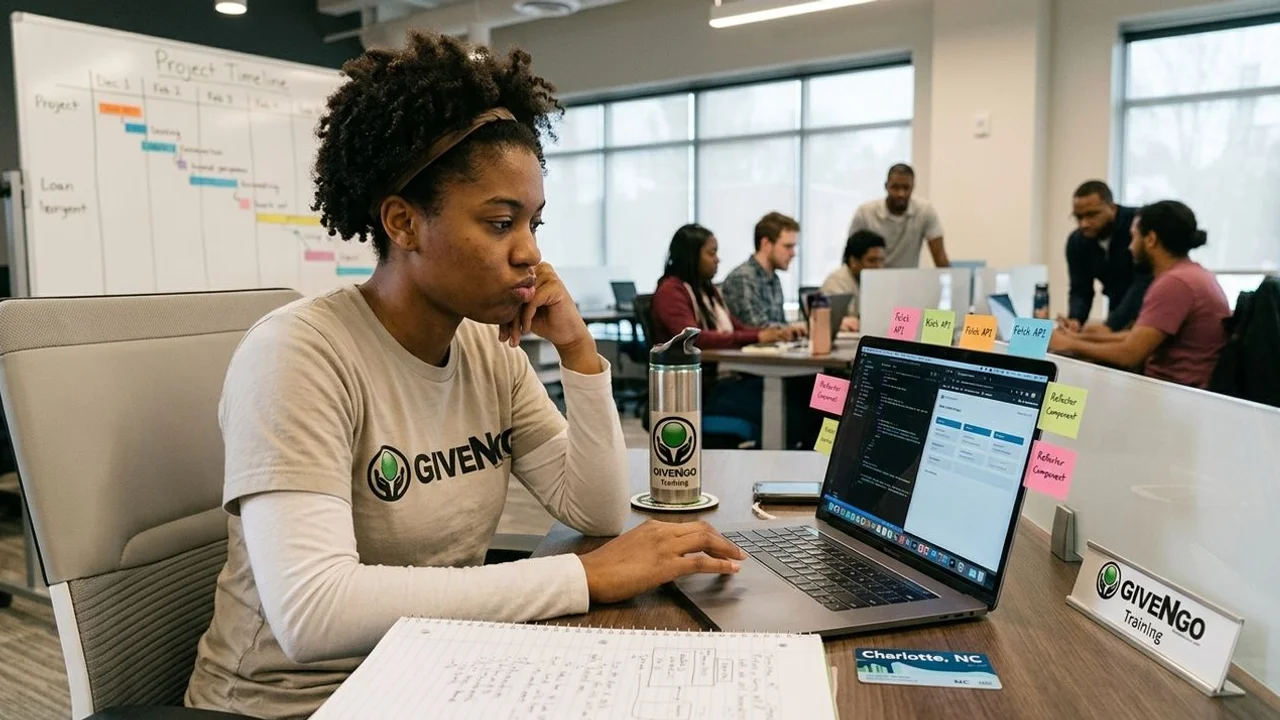
As a professional service team, we notice that mastering the basics of a coding training curriculum is the true dividing line between a struggling amateur and a confident developer.
This foundational focus is exactly why the Web Development & Coding Training track at Give N Go is entry-level by design. Our team built this program to help local business owners upskill their staff and residents transition into lucrative tech careers.
For those seeking entry level coding, Charlotte front-end developers average around $99,183 a year according to a 2026 ZipRecruiter report. We will break down the four core modules of this track and explain exactly what you can expect to achieve. Let’s explore the data behind these skills and the practical projects that make trainees employable.
Module 1: HTML
Module 1 covers the foundational building blocks of the web through HTML. Our approach ensures you understand document structure, forms, and accessibility standards from day one.
A recent 2026 report from WebAIM found that 95.9% of homepages have detected WCAG 2 failures. We emphasize correct semantic tags and alt text to prevent these common accessibility errors. Testing your code early with the W3C Markup Validation Service is a crucial practice for avoiding messy structural bugs later.
- Document structure. DOCTYPE, head, body, semantic tags.
- Forms and inputs. Validation basics.
- Accessibility. Alt text, labels, semantic landmarks.
Module 2: CSS
CSS is the styling language that turns a plain HTML document into a visually engaging experience. We teach CSS so that trainees can build responsive, modern layouts that work on any screen size.
Global internet traffic via mobile devices reached a staggering 64% by mid-2025 according to SQ Magazine data. Our curriculum heavily features mobile-first basics and media queries to meet this growing demand. Mastering the Chrome DevTools element inspector will save you hours of frustration when debugging grid and flexbox layouts.
- Selectors and specificity.
- Box model. Margin, padding, border, content.
- Layout. Flexbox and grid fundamentals.
- Responsive design. Media queries, mobile-first basics.
Module 3: JavaScript
JavaScript breathes life into static pages by adding interactivity and complex logic. We focus heavily on DOM manipulation and asynchronous basics because these are the core skills employers demand.
Radixweb reports that 98.9% of all websites use JavaScript as a client-side programming language in 2026. Our instructors often remind students that rushing into complex frameworks before mastering fundamental loops and conditionals is a common rookie mistake. The console.log() command will quickly become your best friend for tracking variable states and testing fetch promises.
- Variables, types, operators.
- Functions, conditionals, loops.
- DOM manipulation. Selecting elements, listening to events, updating UI.
- Async basics. Fetch and promises at the introductory level.
Module 4: Project + Portfolio
This final module bridges the gap between learning syntax and delivering a real product. We guide trainees through building their first site from spec all the way to deployment.
Hiring managers consistently favor candidates with a live, hosted portfolio over those who just list skills on a resume. Our preferred approach involves teaching static hosting tools like Netlify, Cloudflare Pages, and GitHub Pages for fast, reliable site delivery. Committing your code frequently with Git is a professional habit that shows employers you understand standard source control workflows.
- First project. A small site built from spec to deployment.
- Source control. Git fundamentals, branches, commits, push to a repo.
- Deployment. Static hosting (Netlify, Cloudflare Pages, GitHub Pages).
- Portfolio build. Two to three small projects polished for review.
What Trainees Walk Out With
Graduates of this track leave with more than just a certificate of completion. Our primary objective is to build your confidence to step into a junior role or a more advanced bootcamp.
Charlotte area job data from ZipRecruiter in early 2026 shows entry-level web developers earning an average of $77,399 annually. We structure the final deliverables to ensure every trainee has a deployed first site and a small portfolio to show at interviews. Having working knowledge of HTML, CSS, and JavaScript foundations makes you immediately valuable to local technical teams.
- Working knowledge of HTML, CSS, and JavaScript foundations.
- A deployed first site.
- A small portfolio.
- Source control fluency.
- Confidence to step into a junior role or a more advanced bootcamp.
What’s Not in the Coding Training Curriculum
A focused web development beginner course requires making tough choices about what to exclude. We deliberately leave out advanced topics to ensure absolute mastery of the basics first.
Cramming too many languages into a short timeframe is a common pitfall that leaves students overwhelmed and underprepared. Our track avoids backend frameworks, databases, and native mobile development for iOS and Android entirely. These senior-level concepts represent the next steps after finishing the Give N Go entry program.
- Backend frameworks
- Databases
- Mobile (native iOS / Android) development
- Senior-level concepts
Career Direction
Planning your next professional move is just as important as writing the code itself. Our career support resources help you translate your new portfolio into a compelling job application.
A quick comparison of common entry-level paths shows exactly where your new skills fit into the industry.
| Career Path | Expected Average Salary (2026) | Primary Focus |
|---|---|---|
| Junior Front-End Developer | $77,399 (Charlotte, NC) | Building UI and managing client-side logic |
| Advanced Bootcamp Prep | Education Phase | Transitioning to full-stack and backend systems |
| Freelance Web Designer | $35 to $50 per hour | Creating landing pages for local businesses |
We mapped out the specific steps and wage details for these roles to give you a clear roadmap. For full wage and direction detail, see entry-level web developer careers.
Apply
Taking the first step in your new tech career starts with a simple application.
Our admissions team reviews candidates based on enthusiasm and a desire to learn, not prior experience. This coding bootcamp alternative is completely tuition-free for accepted participants.
We encourage you to reach out directly using the Contact us page to get started. Secure your spot today and start this coding training curriculum on the right foot.
Common Questions
Will this make me a senior developer?
Do I need a laptop?
Web or mobile?
Ready to start Coding?
Tuition-free for accepted participants. Apply, refer a student, or talk to a partner about hiring graduates.