
What You'll Learn in PACT — the 25% Classroom / 75% Work-Based Model
Inside the PACT curriculum: 25% classroom learning, 75% work-based hours. Construction fundamentals, safety, tools, carpentry/electrical/plumbing basics, employability skills.
You probably notice how hard it is to find reliable contractors for your property these days.
Our team certainly feels the pinch of the skilled labor shortage every single week. Associated Builders and Contractors reported that the US construction industry needs about 349,000 net new workers in 2026 just to keep up with demand.
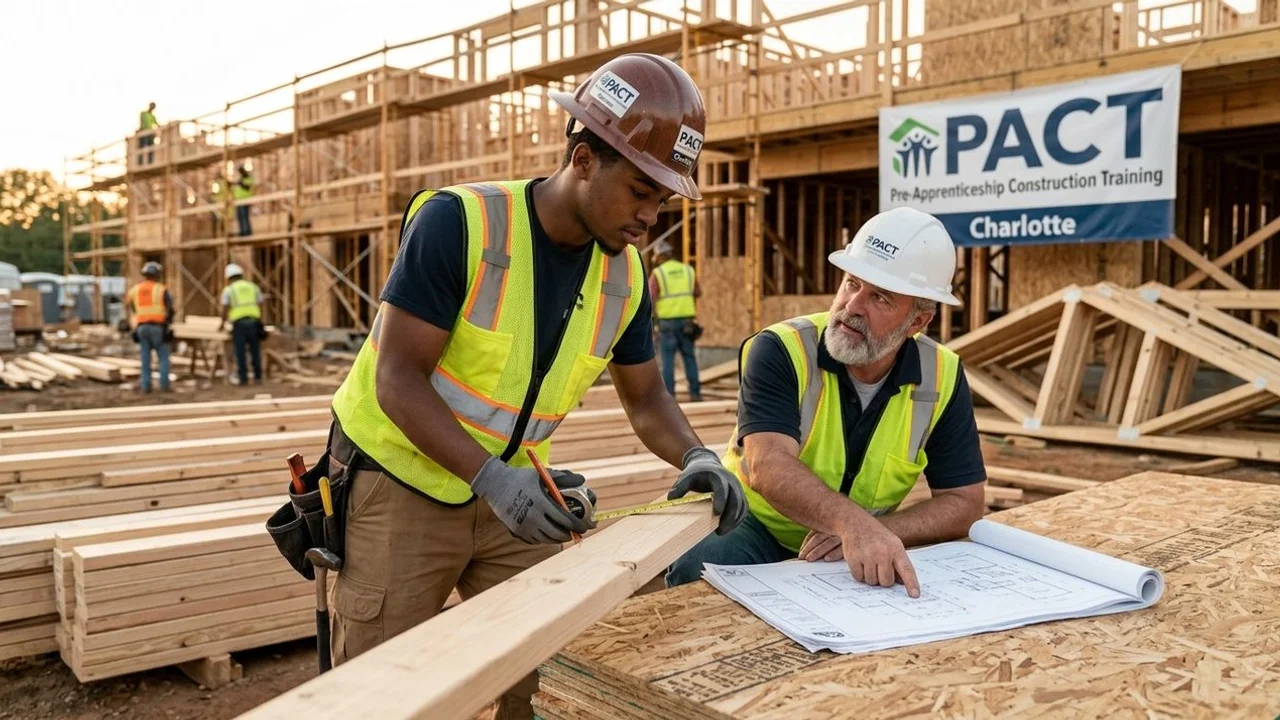
PACT Pre-Apprenticeship runs on a fixed ratio of 25% classroom and 75% work-based training. That ratio is the spine of the program curriculum. Without it, pre-apprenticeship is just school. Let’s examine how this specific training model produces the professional crews you actually want working on your home or business.
Why the 25/75 Split
Pre-apprenticeship sponsors expect graduates to walk onto a job site and contribute on day one. That does not happen from a class, which is why the 25/75 split mandates real hours over desk work.
Our professional service network relies on this exact model to evaluate new hires. The Home Builders Institute (HBI) notes that graduates of this 75% hands-on system achieve an 80% job placement rate.
The Value of Site Discipline
Charlotte employers in the Home Builders Association and partner mechanical contractors consistently report that PACT graduates show up with site discipline most entry candidates lack. That level of discipline is the direct effect of the 75% field time.
Project delays often stem from a lack of trained hands, making this hands-on time critical for local homeowners waiting on renovations. Our crews prefer working alongside these graduates because they already understand the pace of a real job site. You will notice the difference in efficiency when trained apprentices are on your property.
| Focus Area | Standard Trade School | PACT 25/75 Model |
|---|---|---|
| Hands-On Experience | Mostly theory | 75% active job site work |
| Job Readiness | Needs extensive onboarding | Day-one site discipline |
| Safety Training | Basic overview | OSHA 10 Certification required |
The 25/75 split provides immediate benefits for property owners:
- Faster project completion: Trained hands prevent costly delays.
- Higher quality control: Real-world practice translates to fewer mistakes.
- Improved site safety: Hands-on discipline reduces accidents.
What Happens in the 25% (Classroom)
If you are wondering what does pact teach, the classroom portion covers the theoretical foundation required to keep a job site safe and efficient. Trainees learn construction fundamentals, safety protocols, and trade vocabulary before they ever touch a power tool.
We appreciate that this pact program curriculum aligns directly with the National Association of Home Builders (NAHB) Green Building Standard. This ensures the workers upgrading your property understand modern, energy-efficient practices.
Classroom modules cover:
- Construction fundamentals. Trade vocabulary, blueprints, basic math, and accurate measurement techniques.
- OSHA 10 safety. A formal credential required by most US construction employers to prevent accidents on your property.
- First aid and CPR. Standard job-site preparedness for medical emergencies.
- Tools and materials. Hand-tool fluency, fasteners, lumber grading, and common piping like PEX and PVC.
- Trade introductions. Carpentry, electrical, plumbing, and green building basics.
- Employability skills. Resume basics, time management, and workplace communication.
What Happens in the 75% (Work-Based)
The 75% work-based segment puts trainees directly into the field under professional supervision. This is the heart of the pact 25 75 model, transforming classroom theory into muscle memory.
Our project managers see the value of this field time when these apprentices step onto our active sites. Trainees often complete their hours through community partnerships, such as Habitat for Humanity residential builds. This gives them real-world experience framing houses and running wire before they ever bid on your private home renovation.
This is the core of the program:
- Supervised work hours. Real construction tasks under a mentor.
- Community-service builds. Affordable-housing rehabs, neighborhood repairs, and public projects.
- Trade rotations. Time across multiple trades so trainees can pick a track.
- Documentation. Hours are logged for credential and apprenticeship eligibility.
A Typical Week
A typical week divides a student’s time between focused classroom instruction and multiple days of supervised fieldwork. Schedules adapt by cohort, but the structure always prioritizes that core 25/75 balance.
Our partners at the Charlotte-Mecklenburg Schools (CMS) integrate this directly into their career and technical education (CTE) pathways. Youth-track cohorts schedule around the CMS school calendar to keep students on track for graduation.
A representative week looks like:
- Monday morning. Classroom: trade fundamentals or an OSHA 10 module.
- Monday afternoon. Tool prep, safety review, and dispatch to the job site.
- Tuesday to Thursday. Full days on a Charlotte work site or community build, with mentor supervision.
- Friday. Half-day classroom (LST, employability skills, code intro), and half-day reflection or portfolio work.
Life Skills Training (LST)
Life Skills Training (LST) is the soft-skills layer running through every cohort to teach workplace professionalism. It covers decision-making, conflict resolution, goal-setting, and the communication skills property owners expect from service teams.
We know that technical skills do not matter if a contractor cannot communicate clearly with a client. LST is one of the main reasons PACT retention holds where other programs leak. Trainees learn how to interact professionally with homeowners, handle stress, and manage their schedules.
Our industry relies on this kind of character development just as much as technical know-how.
“Clear communication and workplace professionalism are just as critical to a successful build as a level foundation.”
You want workers on your property who respect your time and space. See our Life Skills Training and family support guide for the family-engagement detail.
Evaluation Milestones
Instructors evaluate PACT trainees through strict hours tracking, safety observations, and hands-on skill demonstrations. The “on track” framing replaces letter grades, so trainees know exactly what practical skills they need to demonstrate.
Our hiring managers look for these specific milestones rather than standard report cards. The Home Builders Institute often utilizes the National Occupational Competency Testing Institute (NOCTI) to verify these skills objectively. This guarantees that a trainee holding a certificate has actually mastered the work.
PACT trainees are evaluated against:
- Hours logged. Toward credential and apprenticeship eligibility.
- Safety competence. OSHA 10 completion and daily site behavior.
- Trade skill checkpoints. Per-trade rubrics (proper PEX crimp, correct electrical splice, safe table-saw use).
- Employability. Resume-ready, interview-ready, on-time, and communicating clearly.
What You Earn
Graduates earn a USDOL-recognized credential, an OSHA 10 completion card, and a documented record of hands-on hours. This creates an employer-ready resume that stands out to top-tier service companies.
We actively recruit individuals who hold these specific qualifications. From there, the next step is typically a Registered Apprenticeship, internship, or entry-level skilled-trade job through Give N Go’s partner network.
“A certified workforce directly protects your property investment by ensuring repairs are done right the first time.”
Top experienced workers in specialties like carpentry can eventually earn median salaries upwards of $61,547 annually in the US. The pact training schedule ensures they are ready to earn those wages by being productive immediately. Property owners benefit directly by having these highly certified individuals maintaining their buildings.
Apply or Refer
You can apply or refer a student at any point during the year due to the rolling enrollment structure. This flexibility helps local programs constantly feed new talent into the local workforce.
Our community thrives when more individuals find stable, rewarding careers in the trades. Contact us to apply or refer a student.
We welcome new candidates ready to put in the work. Building a stronger local workforce with the pact program curriculum starts with a single application.
Common Questions
How long does PACT take to complete?
What kind of work-based hours count?
Is the work paid?
Ready to start PACT?
Tuition-free for accepted participants. Apply, refer a student, or talk to a partner about hiring graduates.