
EPA 608 Certification: What It Is and Why HVAC Techs Need It
EPA 608 in plain English: the four sub-types, who needs it, how Give N Go preps trainees, and what it means for Charlotte HVAC careers.
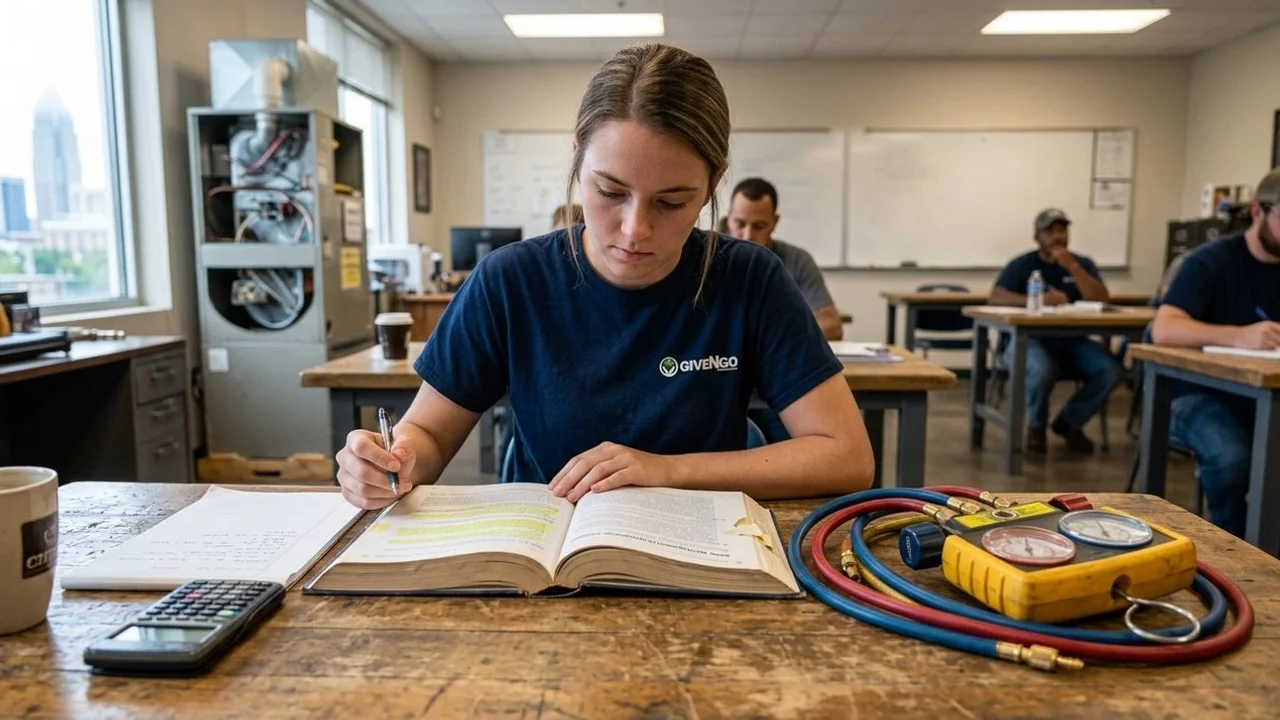
We know that managing commercial cooling issues often feels like a race against the clock. The real liability nightmare begins when uncertified workers start handling sensitive chemical refrigerants. The EPA 608 certification is a federal requirement under Section 608 of the Clean Air Act.
Our technicians undergo rigorous testing to secure this exact credential before stepping on your property. Any professional who handles refrigerant needs the definitive refrigerant certification HVAC companies require to stay compliant with strict federal laws. For local mechanics, there is no legitimate Charlotte HVAC career path without it.
We will break down the latest compliance data and show you exactly how to verify your service team.
Why It Exists
Old-generation refrigerants, managed under early section 608 cfc guidelines, severely damaged the ozone layer. Newer synthetic coolants still have a massive global warming impact. Our training protocols emphasize the exact environmental regulations required to stop dangerous chemical releases.
The Environmental Protection Agency heavily regulates chemical handling to protect the atmosphere. As of January 1, 2026, the American Innovation and Manufacturing (AIM) Act introduced strict new reporting rules. We closely monitor these updates to protect local properties from sudden compliance violations.
The EPA just lowered the mandatory leak detection threshold from 50 pounds down to 15 pounds of refrigerant. This drop means standard commercial office HVAC systems now face intense federal scrutiny. Our certified technicians accurately calculate these new leak rates to keep your equipment legal.
Property owners and solo operators face severe consequences for ignoring the law. The EPA can issue fines of up to $44,539 per day for each major violation. We ensure you never have to worry about paying these massive financial penalties.
Important 2026 Regulatory Updates:
- 15-Pound Threshold: Systems with 15 pounds of high-GWP refrigerants now require mandatory leak calculations.
- Strict Repair Timelines: Technicians must complete verified repairs within 30 days of finding a leak.
- HFC Phasedown: The EPA mandates an 85 percent reduction in total HFC production by 2036.
Our operations integrate these exact timelines into every standard maintenance plan. Compliance is a mandatory requirement for serious property managers. The EPA 608 card is the definitive proof that a worker knows the rules.
The Four Sub-Types
The certification splits into distinct categories based on system pressure and total size. The table below breaks down the specific equipment covered by each federal license.
| Sub-Type | Covers | Typical Equipment |
|---|---|---|
| Type I | Small appliances (under 5 lbs refrigerant) | Window units, mini-fridges, drinking fountains |
| Type II | High-pressure refrigerants | Most residential and commercial AC, heat pumps |
| Type III | Low-pressure refrigerants | Large chillers (less common for residential) |
| Universal | All three | Combined, most flexible |
Our recommendation for any serious professional is to secure the Universal certification immediately. Most Charlotte residential service technicians aim for this specific tier.
A Universal credential is the most flexible and guarantees a worker can handle any system on your property. We see exactly how this prevents frustrating delays during complex commercial repairs.
Service mechanics working exclusively on industrial chillers might only add Type III. A candidate holding a Universal card has passed the 25-question exams for all three types plus the Core section. Our facility clients strongly prefer hiring teams with Universal credentials to simplify their vendor lists.
Who Needs It
Federal law dictates the exact actions that require this government credential. Anyone servicing, repairing, or disposing of equipment containing regulated refrigerants must hold an active card. Our management reviews these strict requirements annually to guarantee total compliance.
If a technician performs any of the following tasks, certification is legally required:
- Opens a closed refrigerant circuit.
- Recovers, recycles, reclaims, or transfers chemical coolants.
- Attaches hoses and gauges to a system to check internal pressures.
- Disposes of heavy equipment containing old refrigerants.
We verify these exact credentials before any technician touches a commercial or residential unit. That broad federal definition covers virtually every active professional working in the field today. Even basic residential maintenance work requires a fully licensed professional. Our specific training programs ensure no one operates outside of these legal boundaries.
A common mistake business owners make is allowing uncertified in-house staff to check AC pressures via service ports. This simple diagnostic action is a direct violation of the Clean Air Act. We protect your corporate liability by ensuring every gauge attachment is done by a vetted pro.
What’s on the Exam
The test is a strictly monitored written exam administered by an approved organization like the ESCO Group or SkillCat. It functions as a closed-book assessment of environmental science and practical safety protocols. We prepare our students to completely master these exact testing conditions.
The assessment covers two primary areas of technical knowledge:
- Core section: Required by all candidates. This part covers ozone depletion, recovery rules, leak repair, and handling laws.
- Sub-type sections: Type I, II, or III specifics. Universal candidates must take all three specialized tests.
Our instructors focus heavily on the complex leak detection rules updated for 2026. Pass thresholds vary slightly depending on the approved testing body administering the exam. A candidate must typically score at least 70 percent on each distinct section to certify. We see many unprepared testers fail the Core section simply because they underestimate the record-keeping questions.
Proper documentation is just as important as mechanical skill on the modern exam. The EPA now requires commercial facilities to retain maintenance records for a minimum of three years. Our curriculum highlights these paperwork requirements so technicians can protect your business from audit fines.
How Give N Go Preps You
The HVAC training track integrates EPA 608 prep directly into the main cohort schedule. Practice questions and hands-on drills build genuine confidence before the final test day. Our expert instructors supervise all physical refrigerant handling to build muscle memory safely.
The program delivers readiness through three specific focus areas:
- Clear Study Plans: Students follow a roadmap designed to simplify dense federal statutes.
- Practical Translation: The curriculum translates complicated government regulations into clear action steps for the job site.
- Modern Equipment Training: Trainees use modern recovery machines that meet the latest 2026 low-emission standards.
We immediately connect you to an approved local EPA 608 Charlotte testing site to sit the official exam. This hands-on equipment experience translates directly to much faster repair times on your property. Our ambitious graduates leave the program fully ready to tackle serious commercial and residential cooling challenges.
Proper education stops the accidental chemical releases that trigger massive government fines. If you are a business owner looking to upskill your internal facility team, this track provides immense immediate value. We ensure every participant understands the real-world weight of this federal license.
What the Card Means in Charlotte
EPA 608 Universal on a resume is the exact difference between an inexperienced trainee and a hireable professional. Charlotte residential service companies absolutely expect this qualification on day one. Our local corporate partners actively seek out graduates holding this specific credential.
Apprenticeship sponsors always look for the card as undeniable proof of serious career commitment. Commercial real estate firms in Mecklenburg County now routinely audit their vendor credentials. We advise all property managers to request proof of certification before signing any annual service contract.
Financial Impact: The 2026 AIM Act phasedown has severely reduced the national supply of chemical refrigerants, making replacement coolant more expensive than ever.
Our certified technicians save you money by fixing leaks correctly the very first time. An uncertified worker guessing at a complex repair will cost your business thousands in wasted materials. The EPA 608 card guarantees a baseline of environmental awareness and mechanical competence. We dispatch only these fully qualified experts to service your valuable equipment.
Costs
The exam itself carries a mandatory fee that varies by the testing organization you select. Taking the assessment online or in person usually costs between 25 and 150 dollars. Our program coordinators help trainees manage these confusing fee structures.
Some Give N Go cohorts feature complete sponsorship coverage for certification vouchers. You should bring this topic up at intake so the staff can review your funding options. We will let you know exactly what financial support is available for your specific cohort.
Failing to secure the proper federal license carries a much higher hidden cost. A solo technician caught violating the Clean Air Act faces that staggering daily fine of $44,539. Our highly transparent pricing ensures you get the necessary training without the fear of massive compliance penalties.
Apply
Contact us to start the HVAC track and secure your professional future. The comprehensive program is entirely tuition-free for accepted participants.
We look forward to helping you build a compliant and highly successful career.
Common Questions
Does EPA 608 expire?
Which sub-type should I get?
Is the test hard?
Ready to start HVAC?
Tuition-free for accepted participants. Apply, refer a student, or talk to a partner about hiring graduates.