
HVAC Training in Charlotte: Tools, Skills, and Safety
Inside Give N Go's HVAC curriculum: refrigeration cycle, manifold gauges, multimeters, OSHA 10, EPA 608 prep, and the lab work that prepares Charlotte techs.
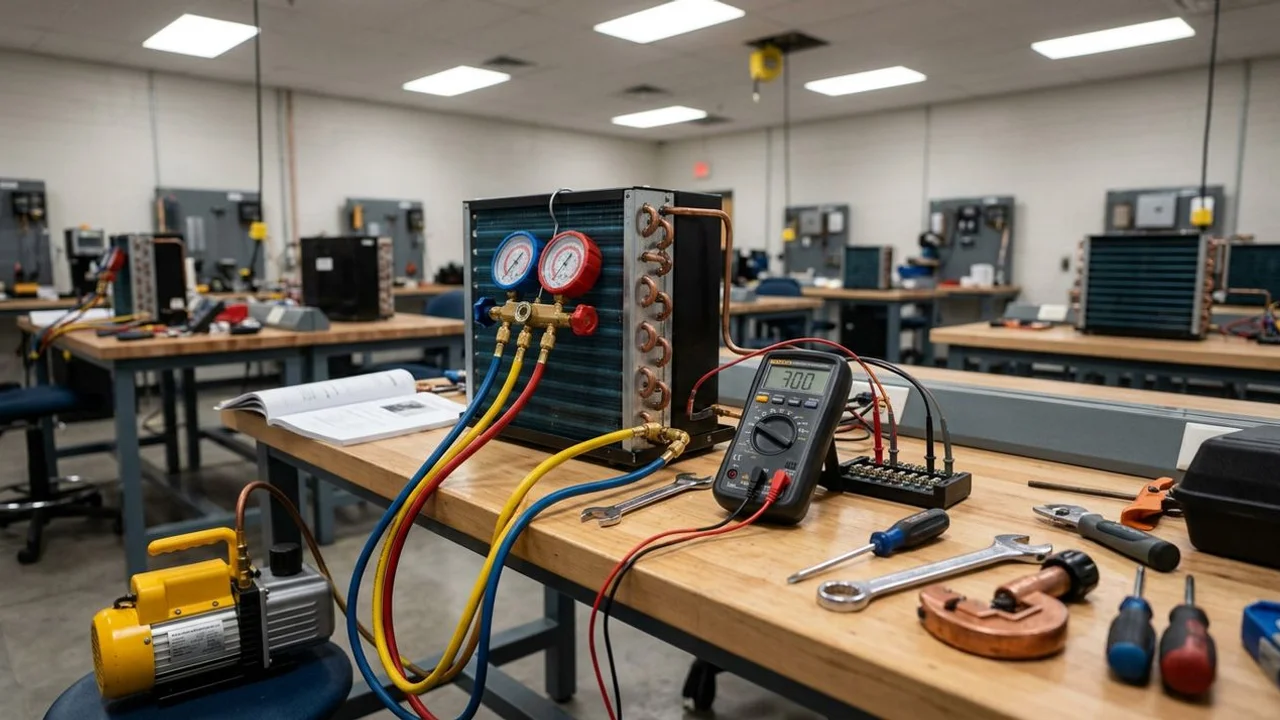
Our team consistently hears that finding technicians with proper, modern training is the biggest hurdle for property managers right now. Give N Go’s HVAC Training curriculum is built around the exact work a Charlotte residential or light-commercial technician actually does.
The curriculum features four core modules and an EPA 608 capstone. We built this specific path because a 2025 Bureau of Labor Statistics report shows HVAC jobs growing by 9% nationwide over the next decade.
This rapid expansion often pushes under-trained workers into the field before they are ready.
A strong foundation separates the standard service calls from the truly great ones.
Our structured approach ensures trainees master the fundamentals before they touch your expensive equipment. Let’s look at the data behind the training.
The following breakdown will walk through the exact modules and safety standards that shape a top-tier technician.
Module 1: The Refrigeration Cycle
We teach every technician that heat never disappears from a building. It simply moves from one space to another. The refrigeration cycle is exactly how it moves, and every professional needs to picture it cleanly.
Our training forces students to memorize the core stages of this cooling process. A system starving for refrigerant behaves very differently than one that is overcharged. The critical components include:
- We start with the compressor, which pressurizes refrigerant gas.
- The condenser then releases heat outside as the gas turns to liquid.
- A metering device drops the pressure suddenly.
- Our next focus is the evaporator, where liquid absorbs indoor heat and turns back to gas.
- The gas finally travels back to the compressor.
- This continuous loop maintains the climate in your building.
We require trainees to read pressure-temperature charts accurately. A simple misreading can lead to severe equipment damage. Connecting symptoms back to their origin point is the key to fast repairs.
Module 2: Tools and Test Equipment
Our hands-on lab time introduces the specific hvac tools training required for modern diagnostics. Accurate measurements are the heartbeat of any successful repair. The top professionals use a mix of traditional and digital equipment.
Digital vs. Traditional Gauges
We ensure every student practices with manifold gauge sets on live systems. Connecting service ports properly prevents dangerous refrigerant leaks. Students learn to read high and low sides before recovering refrigerant safely.
| Feature | Yellow Jacket 42004 (Analog) | Fieldpiece SM480V (Digital) |
|---|---|---|
| Primary Benefit | Extremely durable brass body | Advanced Bluetooth syncing |
| Best Use Case | Basic pressure readings | Complex system diagnostics |
| Professional Value | Maintains accuracy under stress | Speeds up data logging by 50% |
Essential Diagnostic Gear
Our inventory includes the latest testing equipment. Multimeters verify voltage, continuity, and capacitor microfarads. Vacuum pumps and micron gauges pull a deep vacuum before charging.
- We provide essential hand tools for cutting, swaging, flaring, and brazing.
- The 2026 Fieldpiece SM480V digital manifold is a featured training tool due to its four-port accuracy.
- Traditional analog gauges like the Yellow Jacket 42004 are also utilized for their unmatched durability.
Personal Protective Equipment
Our safety protocol demands proper Personal Protective Equipment at all times. Eye, hand, and hearing protection are non-negotiable on the job. Refrigerant-handling safety protects both the worker and your property.
Module 3: OSHA 10 and Site Safety
We integrate OSHA 10 certification directly into the training cohort. Charlotte construction and service employers want to see OSHA 10 on every resume. Site safety directly impacts your liability as a property owner.
Our instructors emphasize the serious statistics surrounding workplace accidents. A recent 2025 safety report highlights that falls cause 33.5 percent of all construction fatalities. Proper ladder safety and fall protection protocols save lives.
We cover the most critical safety regulations in depth. Refrigerant-handling rules align with Section 608 of the Clean Air Act. The primary safety topics include:
- Our modules on hot work and brazing safety prevent accidental fires.
- Attic and confined-space awareness keeps technicians secure in tight areas.
- OSHA fines for non-compliance can reach $70,000, making this training highly valuable.
Module 4: Controls and Diagnostics
We dedicate significant time to controls because modern HVAC is heavily electronic. A minor wiring issue can shut down an entire commercial heating system. Trainees must master basic electrical theory, including series versus parallel circuits.
Our component testing labs cover capacitors, contactors, transformers, and motors. Voltage drops and Ohm’s law dictate how these systems operate. Understanding these principles stops technicians from simply guessing at the problem.
We guide students through the exact wiring requirements of thermostats and controls. Wiring conventions and common-wire setups are practiced daily. Basic communicating systems require a repeatable diagnostic flow.
Capstone: EPA 608
Our final requirement is the federal certification required for any tech handling refrigerant. The Environmental Protection Agency strictly monitors these chemicals to prevent ozone depletion. Working without this credential can result in federal fines exceeding $44,000 per day.
We prepare trainees for all four sub-types of the exam. Type I covers small appliances, while Type II handles high-pressure systems. Type III is for low-pressure chillers, and the Universal pass covers everything.
Our goal is to ensure every graduate achieves the Universal level for maximum flexibility. For the deeper guide, see EPA 608 certification explained. A $10,000 whistleblower reward exists for reporting violations, proving how seriously the government takes this law.
What You Walk Out With
We ensure every graduate leaves with documented lab and job-site hours. This hands-on experience translates immediately into reliable service. Property managers notice the efficiency of a properly educated technician.
Our program delivers the exact qualifications employers demand. The concrete achievements include:
- A USDOL-recognized PACT credential to verify skills.
- We confirm their EPA 608 readiness before they enter the field.
- OSHA 10 completion proves their commitment to safety.
- Direct introductions to Charlotte HVAC employers in the Home Builders Association network provide immediate opportunities.
How You Apply
Our enrollment process is straightforward for accepted participants. The program is entirely tuition-free to remove financial barriers.
Rolling enrollment means new cohorts are frequently beginning.
We encourage interested individuals to take the next step. To discuss the hvac course outline charlotte employers prefer, simply Contact us.
A skilled career in climate control is waiting for you.
Common Questions
Do I need to bring my own tools?
How much time do I spend in lab vs job sites?
What gets tested?
Ready to start HVAC?
Tuition-free for accepted participants. Apply, refer a student, or talk to a partner about hiring graduates.