
Who Qualifies for HVAC Training in Charlotte?
Eligibility for Give N Go's tuition-free HVAC track in Charlotte. Age, education, conditions, and what to bring to intake.
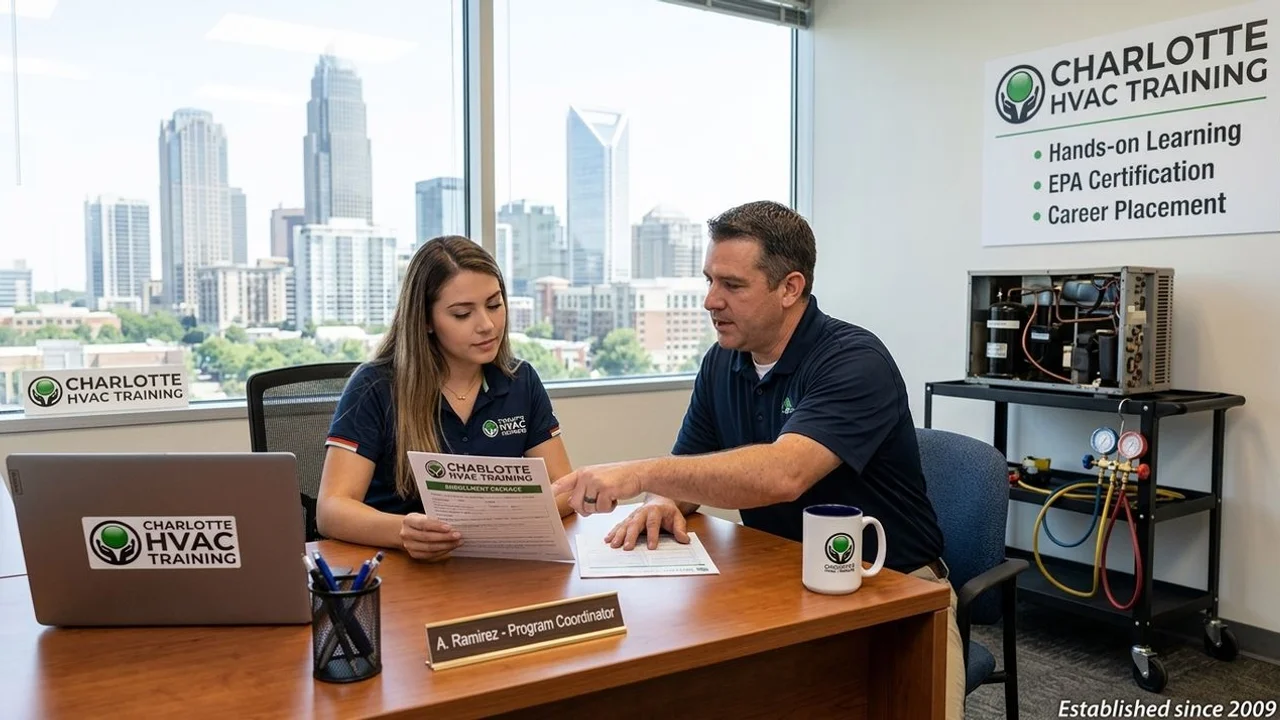
We personally know how challenging it is to find reliable technicians. Finding someone who truly understands modern heating and cooling systems is a common struggle for local property managers. The Give N Go HVAC Training program simplifies the requirements Charlotte residents must meet to enter this lucrative field.
Our HVAC track runs under the broader PACT eligibility framework. Standard rules still apply here, with a few extra lab considerations added into the mix.
Recent 2026 data from the Bureau of Labor Statistics projects an 8% job growth for HVAC mechanics over the next decade.
We design our curriculum to meet this surging demand head-on. This ensures every homeowner and business owner gets top-tier service.
Let’s explore the core eligibility rules, the specific certifications involved, and the practical steps to apply.
Core Eligibility: HVAC Training Requirements Charlotte
Our training program has simple core eligibility requirements, welcoming youth 14 to 17 and adults 18 and older without requiring a high school diploma. According to 2026 data from ZipRecruiter, the median annual pay for an HVAC installation technician in Charlotte sits around $53,446. This competitive wage makes the trade a highly valuable career path.
We welcome applicants from all walks of life into the training pipeline. The basic requirements are designed to be accessible. You do not need a prior technical background to succeed here.
- Age. Youth 14 to 17 join the youth track, while adults 18 and older enter the adult track.
- Residency. Applicants must live in Charlotte-Mecklenburg or surrounding referral areas.
- Education. No high school diploma is required to start, school enrollment is fine, and break schedules are accommodated.
- Justice involvement. Most records do not disqualify you, and cases are coordinated individually to align with North Carolina’s Second Chance initiatives.
Our team reviews every application with a focus on future potential. These inclusive guidelines ensure motivated individuals get a fair shot. The goal is to build a skilled workforce that local homeowners can depend on.
What HVAC Adds On Top
We require HVAC trainees to handle physical labor, learn diagnostic tools, and prepare for the EPA 608 certification exam. The trade involves a few extra physical and technical demands compared to other paths. Property managers expect technicians who can handle both heavy lifting and precise diagnostics.
Our instructors spend significant time building your comfort with industry-standard equipment. You will learn to use specialized gear like manifold gauges and Fluke multimeters during lab sessions. No prior experience is required before your first day.
- Physical demand. The job involves climbing ladders, performing attic crawls, and lifting heavy equipment like heat pumps. Trainees should be able to handle physical work or be ready to build into it.
- Tool comfort. Comfort using digital multimeters and pressure gauges develops naturally in the lab environment.
- EPA 608 willingness. You will prep for and sit the EPA 608 certification exam during the cohort.
We coach students extensively on the Federal Clean Air Act regulations behind this exam. Mandated by the federal government, the test covers Core safety, plus Type I, Type II, and Type III appliance categories. If you have test anxiety, simply bring it up at intake so accommodations can be arranged.
What to Bring to Intake
Our team requires you to bring a valid ID, school documents, referral paperwork, and any probation conditions to your intake meeting. Arriving prepared shows professionalism right from the start. Homeowners expect organized technicians, and that habit begins on day one.
We ask that you gather these specific documents before your scheduled meeting. Having these items ready prevents unnecessary delays in your approval. A complete file helps administrators verify your eligibility much faster.
- ID. A valid government-issued photo identification.
- School documents. Transcripts are optional but very helpful for placement.
- Probation conditions. Bring these if applicable so schedules can be aligned.
- Referral paperwork. Include this if a counselor or local agency sent you.
- Prior trade hours documentation. Any proof of previous experience or an existing OSHA 10 safety certification gives you a head start.
Our counselors will review these materials with you in person. This face-to-face meeting ensures all your questions are answered clearly. Missing documents can simply be submitted later if you forget something.
How You Apply
We require applicants to submit an online contact form before scheduling an intake conversation and eligibility review. Getting started only takes a few minutes online. The local construction sector is booming, so seats fill up quickly.
Our team processes incoming requests every single business day. You can expect a response within the standard Charlotte industry timeframe of 24 to 48 hours. The entire timeline is structured to get you into a cohort fast.
- Submit the Contact form. Be sure to pick HVAC as your primary track of interest.
- Intake conversation. You will receive a follow-up call within two business days.
- Eligibility review. Administrators will assess your age, schedule, conditions, and overall fit.
- Acceptance. If accepted, you start with the next available group.
Our rolling enrollment policy means you never have to wait for a traditional fall or spring college semester. This flexible scheduling approach saves applicants up to six months of idle waiting time. Starting sooner means you begin earning a professional wage much faster.
Costs
Our Give N Go training program costs zero tuition, charges no application fee, and provides all necessary lab tools. Traditional trade school programs in the United States often cost anywhere from $1,200 to $15,000. Free training makes starting a new career much more accessible.
We provide all the necessary lab equipment during your scheduled hours. A professional-grade starter toolkit from brands like Klein Tools or Fieldpiece easily costs over $500. Borrowing our gear keeps your upfront expenses at absolute zero.
| Expense Category | Traditional Trade Schools | The Give N Go Program |
|---|---|---|
| Application Fee | Often $50 to $100 | $0 (Completely Free) |
| Program Tuition | $1,200 to $15,000 | $0 (Zero Tuition) |
| Required Tools | Student buys own ($500+) | Provided during training |
We coach trainees on exactly which personal tools to invest in once they start working. Building your own tool bag slowly is much smarter than buying everything at once. Business owners appreciate graduates who know how to select high-quality, durable equipment.
Schedule Realities
We run cohorts on a paced schedule using the 25/75 PACT model, which mixes classroom theory with extensive off-site partner shop hours. Training mirrors real-world commercial shifts to prepare you for actual field work. Nearly 80% of construction firms currently struggle to fill skilled labor positions because applicants lack field experience.
Our curriculum relies heavily on off-site partner shop hours to build that missing practical skill. This hands-on approach produces confident technicians who can troubleshoot complex systems immediately. The exact structure is highly respected across the local industry.
- 25% Classroom Theory. Focused on reading blueprints, understanding electrical theory, and mastering safety protocols.
- 75% Hands-On Lab. Dedicated to practical work, wiring thermostats, and turning wrenches in partner shops.
We firmly believe this balance is the secret to producing top-tier talent. Mixing textbook learning with actual shop hours accelerates the mastery of complex concepts. Local employers actively seek out graduates who have trained under this exact ratio.
What If I’m Not Sure HVAC Is My Track?
Our intake counselors can match you across various other construction and technology tracks if you are unsure about HVAC. That initial uncertainty is completely normal for anyone exploring a new career path. Modern home systems are highly integrated, meaning skills often overlap across multiple disciplines.
We see many talented trainees transition smoothly once they understand these connections. For example, installing a modern heat pump requires a solid grasp of basic electrical wiring. The upcoming 2025 North Carolina HEAR rebate program is currently driving massive demand for technicians who understand these blended systems.
- Construction Tracks. Choose from HVAC, electrical, plumbing, carpentry, or welding.
- Technology Tracks. Explore options in fiber optics, IT support, cybersecurity, or coding.
Our team encourages you to bring your long-term income goals directly to the intake meeting. Discussing your interests helps administrators guide you toward the most lucrative local opportunities. Finding the perfect fit ensures you stay motivated throughout the entire learning process.
Apply
We are ready to help you meet the hvac training requirements charlotte employers expect by starting your application today. The local market is expanding rapidly, and skilled technicians have incredible job security.
Homeowners and business operators are actively searching for the expertise you will soon possess.
Our staff is standing by to process your information and answer any lingering questions. Taking the first step is completely free and carries zero obligation. Please visit the Contact us page to submit your hvac training application charlotte form directly or refer a promising student.
Common Questions
Do I need a high school diploma for the HVAC track?
Can I enroll if I'm on probation?
Is HVAC training tuition-free?
Ready to start HVAC?
Tuition-free for accepted participants. Apply, refer a student, or talk to a partner about hiring graduates.