
What Does an HVAC Technician Actually Do Day to Day?
A plain-English look at the work HVAC technicians do across Charlotte residential and light commercial — install, service, repair, and refrigerant handling.
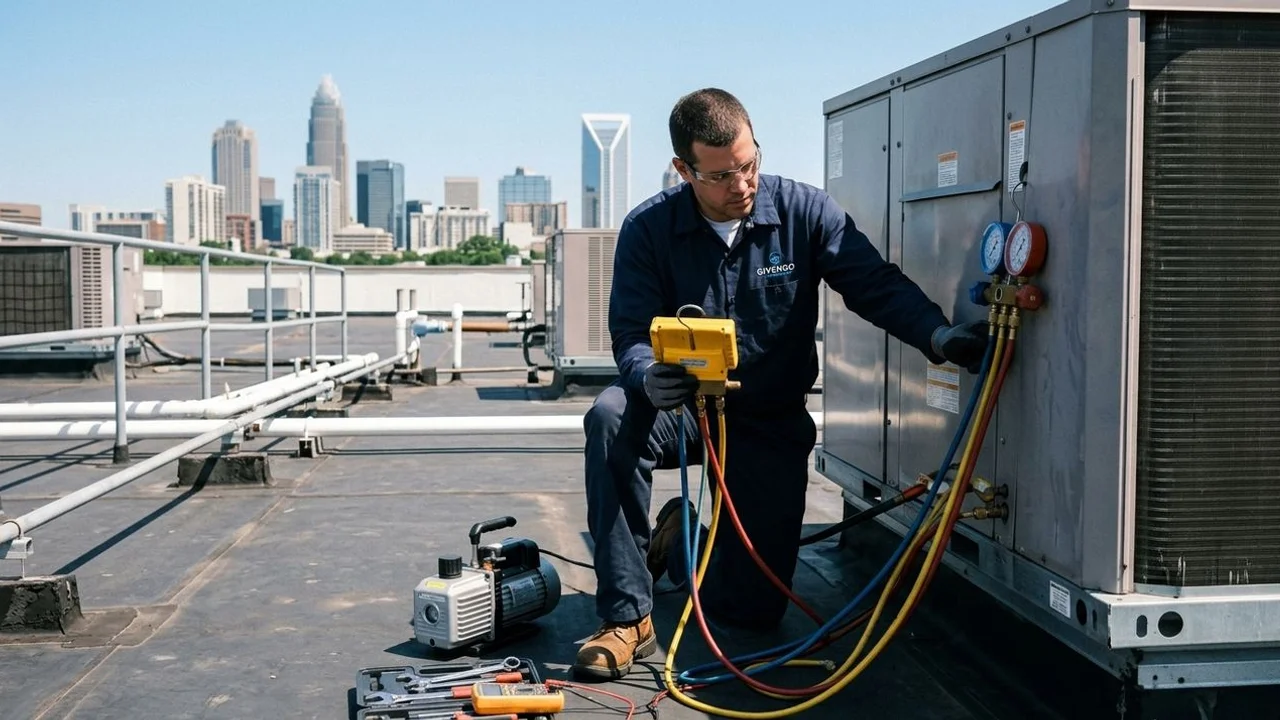
We constantly hear from homeowners and business managers who want to know what exactly happens during a service call. You might see a van pull up and wonder what does an hvac technician do behind the scenes to keep your climate control running.
The reality goes far beyond simply swapping out air filters. With nearly $4 billion in construction projects underway in Charlotte for 2026, the demand for skilled technicians is hitting record highs. This growth means professionals are tackling increasingly complex electrical and mechanical systems.
We are going to break down the daily duties of a field technician, the specific tools required for the job, and exactly what types of projects the local market is hiring for right now.
The Day-to-Day: What Does an HVAC Technician Do?
An HVAC technician installs, services, and repairs heating, ventilation, and air conditioning equipment. Our teams handle everything from complex electrical diagnostics to residential system tune-ups. This hands-on work requires a deep understanding of mechanical codes and safety protocols.
We see a wide variety of tasks depending on whether the job is residential or commercial. A standard service call often starts with preventative maintenance to keep units running efficiently. You will find technicians checking refrigerant pressures, cleaning condenser coils, and replacing worn belts.
A typical Charlotte residential service tech handles these core hvac technician job duties:
- Run a maintenance call. Technicians test capacitors and inspect the flame sensor to prevent seasonal breakdowns.
- Diagnose a no-cool callout. Technicians use multimeters to test contactors and check electrical control circuits before recovering and recharging refrigerant.
- Install a new system. This process involves mounting the air handler, setting the condenser pad, running the line set, brazing fittings, and pulling a vacuum.
- Document the job. Customers receive photos, detailed performance reports, and parts lists for full transparency.
Light commercial operations add another layer of technical difficulty. We frequently service packaged rooftop units and large air handlers for retail spaces. Commercial work often requires coordinating with facility managers to minimize downtime during business hours.
There are currently over 441,000 HVAC technicians employed across the United States. Our field is growing rapidly, but the daily physical demands remain consistent. You can expect to spend time crouching in tight spaces or lifting heavy evaporator coils.
The Tools
A professional technician relies on a highly specialized toolkit to diagnose and repair climate systems safely. We carry electrical meters, pressure gauges, and recovery equipment to handle every phase of a job. Proper gear ensures exact measurements and protects the worker from high-voltage hazards.
We trust professional-grade digital multimeters for accurate electrical troubleshooting. A model like the Fluke 116 is an industry standard because it measures microamps for flame sensors and handles temperature readings from -40 to over 500 degrees Fahrenheit. You cannot safely work on modern furnaces without this level of precision.
Federal regulations also dictate what equipment must be on the truck. We comply with strict environmental laws regarding refrigerant capture and storage. Every technician must carry specific recovery machines to prevent harmful chemicals from venting into the atmosphere.
| Tool Category | Specific Equipment | Primary Application |
|---|---|---|
| Refrigerant Handling | Manifold gauge set, recovery machine | Checking pressures, capturing old refrigerant (legally required). |
| Electrical Diagnostics | True RMS Multimeter (e.g., Fluke) | Testing voltage, continuity, and microfarads for capacitors. |
| System Evacuation | Vacuum pump and micron gauge | Removing air and moisture before charging a new system. |
| Mechanical Work | Copper cutters, flaring kit, brazing torch | Sizing and connecting custom refrigerant lines. |
Every Charlotte HVAC technician also carries EPA 608 certification, which is required by federal law for anyone touching refrigerant. Our technicians know this credential is a lifetime requirement, with the Universal level covering all equipment types. You must pass a proctored exam to earn this status.
What You Don’t Do
You do not spend your days sitting behind a desk or staring at a computer screen. We operate in a highly mobile environment, traveling to different neighborhoods and commercial sites every single day. The role requires constant physical movement and adaptability.
Our technicians rarely work in the same location twice in one week. You will find yourself climbing ladders to access rooftop units or crawling into tight attic spaces to inspect ductwork. This physical stamina is exactly why the trade pays well and offers excellent job security.
Common misconceptions about the daily routine include:
- Predictable environments. Temperatures vary wildly depending on the season and the broken equipment.
- Repetitive tasks. Every diagnostic call presents a unique mechanical puzzle.
- Strictly indoor work. Outdoor condenser units require service in rain, heat, and cold.
We track industry data closely to understand the career outlook. The Bureau of Labor Statistics reported in 2025 that the trade will see about 40,100 new job openings annually through the next decade. You are stepping into a dynamic field with a massive shortage of skilled labor, rather than a stagnant office job.
What Charlotte Specifically Hires For
The local market demands a mix of residential expertise and specialized commercial skills. We see massive opportunities in Charlotte due to steady population growth and major commercial investments. You need to understand the regional construction trends to build an hvac career charlotte employers respect.
Our local economy is transforming the types of systems contractors install. A 2026 report from ABC Carolinas noted that data centers along the I-85 corridor are a massive driver for commercial construction. These specialized facilities require high-capacity electrical setups and redundant mechanical cooling systems.
Charlotte’s market mix currently breaks down into these primary sectors:
- Residential service. Older single-family housing stock pairs with a rapidly growing multifamily build-out.
- Light commercial. Restaurants, retail spaces, and office parks rely heavily on packaged rooftop units.
- New construction. Builders run precise Manual J and Manual D specifications for modern, energy-efficient housing.
- Data centers and healthcare. High-tech facilities require precision cooling, offering premium opportunities for advanced technicians.
- Refrigeration adjacent. Grocery and food-service work provides a steady niche, though it is less common for entry-level workers.
We also see huge demand in the healthcare sector. Expansions by major networks like Atrium Health and Novant Health are creating consistent work for technicians trained in commercial applications. You will find that large-scale commercial projects are dominating the pipeline.
How You Get Started
Securing formal training and earning your federal certifications is the first step. We recommend starting with a structured education program before applying for mechanical apprenticeships. This combination of classroom knowledge and field experience builds a solid foundation.
Our top advice for local candidates is to seek out specialized programs that cover the fundamentals quickly. The clearest Charlotte path is Give N Go’s HVAC training track, followed by a Registered Apprenticeship with a local mechanical contractor. You can often find tuition-free options that include full EPA 608 test preparation.
We always tell new technicians to review the specific HVAC training requirements to see who qualifies. It is also important to understand your earning potential from day one. You can read the HVAC technician salaries guide to see exactly what the local pay path looks like as you gain experience.
Apply or Refer
Launching your new career is as simple as reaching out to a local program. We are actively looking for motivated individuals ready to learn what does an hvac technician do in the real world to build a highly profitable trade. The Charlotte market needs your skills right now.
Our programs remain tuition-free for accepted participants. You can easily Contact us to start the application process.
Take the first step toward a secure technical career today.
Common Questions
Is HVAC residential or commercial work?
Do HVAC techs work outside?
Is HVAC physical?
Ready to start HVAC?
Tuition-free for accepted participants. Apply, refer a student, or talk to a partner about hiring graduates.