
Fiber Splicing, OSP, and ISP Basics
Inside the Charlotte fiber optic curriculum: fusion splicing, Outside Plant vs Inside Plant work, Cat6 cabling, BICSI alignment, and TIA-EIA-568 standards.
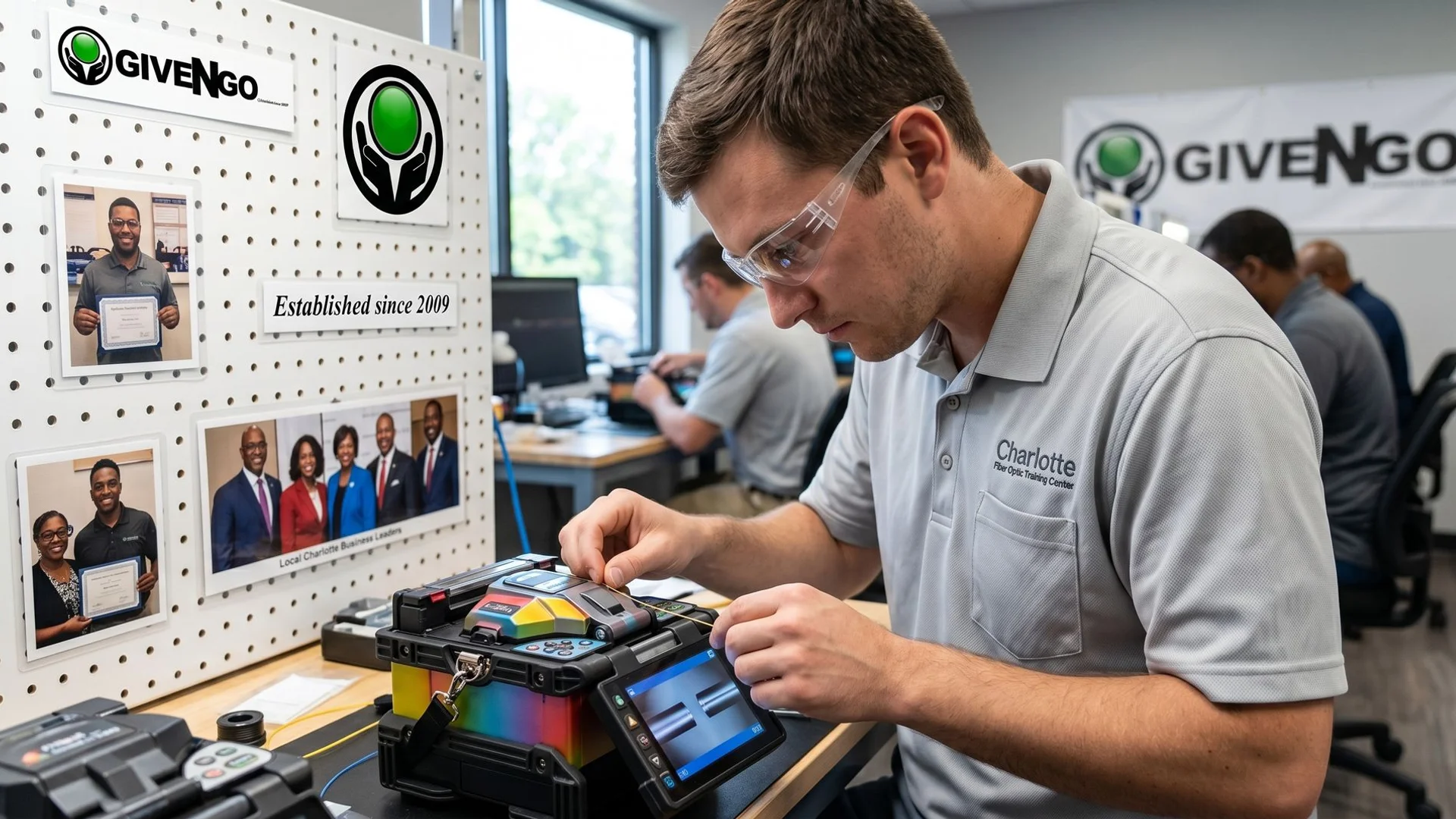
You probably only think about your internet connection when it stops working.
Our team understands that keeping your home or business online requires perfectly installed infrastructure. This reality drives our entire curriculum.
We designed the fiber optic splicing training at Give N Go to master three critical skills: splicing, OSP/ISP work, and structured cabling basics. Each module combines hands-on lab time with strict standards alignment.
Here is a breakdown of how this training protects your connectivity.
Splicing
Splicing is the defining skill of joining two optical cables so light passes through without interruption. Our trainees master this delicate process to ensure your property gets maximum bandwidth.
The Fusion Splicing Process
Fusion splicing joins fiber strands at the molecular level using a specialized tool called a fusion splicer. Modern machines, like the industry-standard Fujikura 90S+, use high-precision core alignment and artificial intelligence to weld glass in just seven seconds. This method is crucial because it keeps signal loss below 0.1 decibels.
Our fusion splicing training requires technicians to follow a strict four-step procedure for every connection.
- Strip: Remove the protective jacket and buffer to expose the bare fiber underneath.
- Cleave: Use a precision cleaver to make a perfectly clean, perpendicular cut across the glass.
- Fuse: The splicer aligns the two ends and arc-fuses them together with an electric spark.
- Protect: A heat-shrink sleeve slides over the joint to protect the fragile splice from damage.
Mechanical Splicing as a Backup
Trainees also learn mechanical splicing as a backup method. Technicians use this technique primarily for emergency restoration when a fusion splicer is unavailable or impractical.
Mechanical splices align the fiber ends inside a small plastic sleeve using index-matching gel. While faster in a pinch, this method typically results in a higher signal loss of 0.2 to 0.5 decibels. Our program focuses on building splicing speed and consistency through repeated lab exercises, ensuring technicians always use the right method for your property.
OSP (Outside Plant)
Outside Plant (OSP) refers to all the outdoor fiber optic infrastructure that brings the internet from the provider directly to your neighborhood. Our osp isp training charlotte program prepares technicians to handle the rugged realities of building this external network.
Outdoor Installation Environments
Outdoor fiber work takes place in several distinct environments. Installers must understand how to work safely in each one to prevent damage to your local grid.
- Aerial: Technicians run cables on utility poles, often working high in the air from a bucket truck.
- Underground: This involves pulling heavy conduit, working in manholes, and entering secure utility vaults.
- Closures: Workers install specialized splice cases that protect delicate glass connections from harsh weather.
- Pedestals: These green cabinet termination points sit above ground in residential neighborhoods.
Real-World Hazards and Documentation
OSP work requires dealing with unpredictable weather, curious wildlife, and the physical demands of bucket-truck operations. Safety protocols and proper personal protective equipment (PPE) are absolute priorities on these sites.
Our technicians also learn the critical importance of checking with local authorities before moving dirt. Calling 811 before any underground dig is a mandatory step to avoid striking existing gas or water lines.
Proper documentation wraps up every successful outdoor job. Technicians must log as-built records, track cable counts, and maintain detailed splice logs. This paperwork is vital for major municipal upgrades, such as the $569,601 fiber optic project in East Charlotte syncing traffic signals along Robinson Church Road through late 2026.
ISP (Inside Plant)
Inside Plant (ISP) covers the indoor fiber work that routes connectivity throughout a commercial building or residential complex. Our training ensures the cables inside your walls deliver the speeds promised by your internet provider.
Indoor Routing and Termination
ISP is generally cleaner and involves lower physical stress than outdoor work, but it requires intense precision. Technicians must work through drop ceilings, utility closets, and crowded server rooms without damaging fragile lines.
- Routing: Installers guide cables through trays, J-hooks, and vertical risers between floors.
- Termination: This step involves adding connectors (like LC, SC, ST, or MTP) to the ends of the fiber for patch panels.
- Patching: Technicians establish cross-connections in Intermediate Distribution Frames (IDFs) and Main Distribution Frames (MDFs).
Our students practice strictly adhering to the bend radius rule. Bending a standard fiber cable tighter than 10 times its outer diameter will cause microbends, instantly degrading your internet speed.
Testing and Certification Standards
Testing proves the network actually works. Commercial customers often require formal certification documentation before they will pay for a job.
We teach technicians to use high-end diagnostic equipment to verify their installations. They perform Optical Time-Domain Reflectometer (OTDR) shots and measure light loss to ensure perfect clarity. Using modern gear like the Fluke Networks CertiFiber Pro allows graduates to certify a multimode fiber link in just three seconds, speeding up project completion times for business owners.
Cat6 / Structured Cabling
Structured cabling provides the copper backbone that connects everyday devices to the high-speed fiber network. Most real-world installations mix copper and fiber to serve different parts of a building.
Our structured cabling curriculum focuses heavily on Cat6 basics. Understanding the limitations of copper is essential for business owners planning a new office layout. For example, a standard Cat6 cable can handle massive 10 Gigabit speeds, but only up to a distance of 55 meters.
Trainees master several core copper installation skills.
- Termination: Punching down wires onto patch panels and attaching RJ45 jacks.
- Cable runs: Managing bundles neatly and respecting copper bend radius rules.
- Testing: Generating Cat6 certification reports to guarantee bandwidth.
- Standards: Following the strict rulebook set by TIA-EIA-568 guidelines.
We align all instruction with the current TIA-568.2-D standards. This ensures every termination point in your office meets modern compliance requirements.
| Cable Type | Maximum Speed | Distance Limit for Max Speed | Best Application |
|---|---|---|---|
| Cat5e | 1 Gbps | 100 meters | Basic office networks, older homes |
| Cat6 | 10 Gbps | 55 meters | Modern workstations, VoIP phones |
| Cat6a | 10 Gbps | 100 meters | Server rooms, long commercial runs |
BICSI Alignment
BICSI is the global credentialing body that sets the highest quality standards for telecommunications infrastructure professionals. The entire track at Give N Go strictly aligns to these rigorous installation guidelines.
Our bicsi training nc curriculum guarantees your property receives work done right the first time. Formal BICSI certification, such as the Installer 1, Installer 2, or Technician levels, typically happens after additional field hours during an apprenticeship or employer-sponsored testing.
“Properly installed infrastructure is the invisible foundation of a reliable business network.”
Employing Information Technology Systems (ITS) credentialed technicians directly benefits property managers. These certified experts follow established fire safety codes, reduce network downtime, and prevent costly rework on large infrastructure jobs.
Smart City and Broadband Context
Smart City projects and rural broadband expansions are rapidly increasing the demand for correctly installed fiber. North Carolina is currently undergoing a massive infrastructure upgrade.
Our graduates are stepping up to build this essential grid across Charlotte and the surrounding region. Several major initiatives require highly trained technicians to ensure long-term reliability.
- Rural Broadband: Providers are using the state’s Growing Rural Economies with Access to Technology (GREAT) grant program to extend lines to thousands of new locations through 2026.
- Urban Upgrades: The $569,601 project in East Charlotte relies on new fiber optic cable to synchronize traffic signals along Robinson Church Road.
- 5G Backhaul: Cellular networks depend entirely on physical fiber connections to handle increased mobile data traffic.
These installations secure stable careers for trainees while directly upgrading your local digital infrastructure. For a deeper look at why this is a massive market gap in the Charlotte area, see fiber optics: NC’s fastest-growing trade.
Apply
Taking the next step is simple for interested candidates. Contact us to learn more about the enrollment process.
Our program is entirely tuition-free for accepted participants. This removes financial barriers, allowing dedicated individuals to focus completely on mastering the trade.
Common Questions
Will I learn both fusion and mechanical splicing?
Is BICSI certification mandatory?
Do I need to learn Cat6 too?
Ready to start Fiber?
Tuition-free for accepted participants. Apply, refer a student, or talk to a partner about hiring graduates.